 ← All regions
 Lucca
Intact Renaissance walls wrap a compact town of towers, opera and olive-oil traditions.
What to see.
Walk the walls by bike
Highlight · Lucca
Puccini's birthplace
Highlight · Lucca
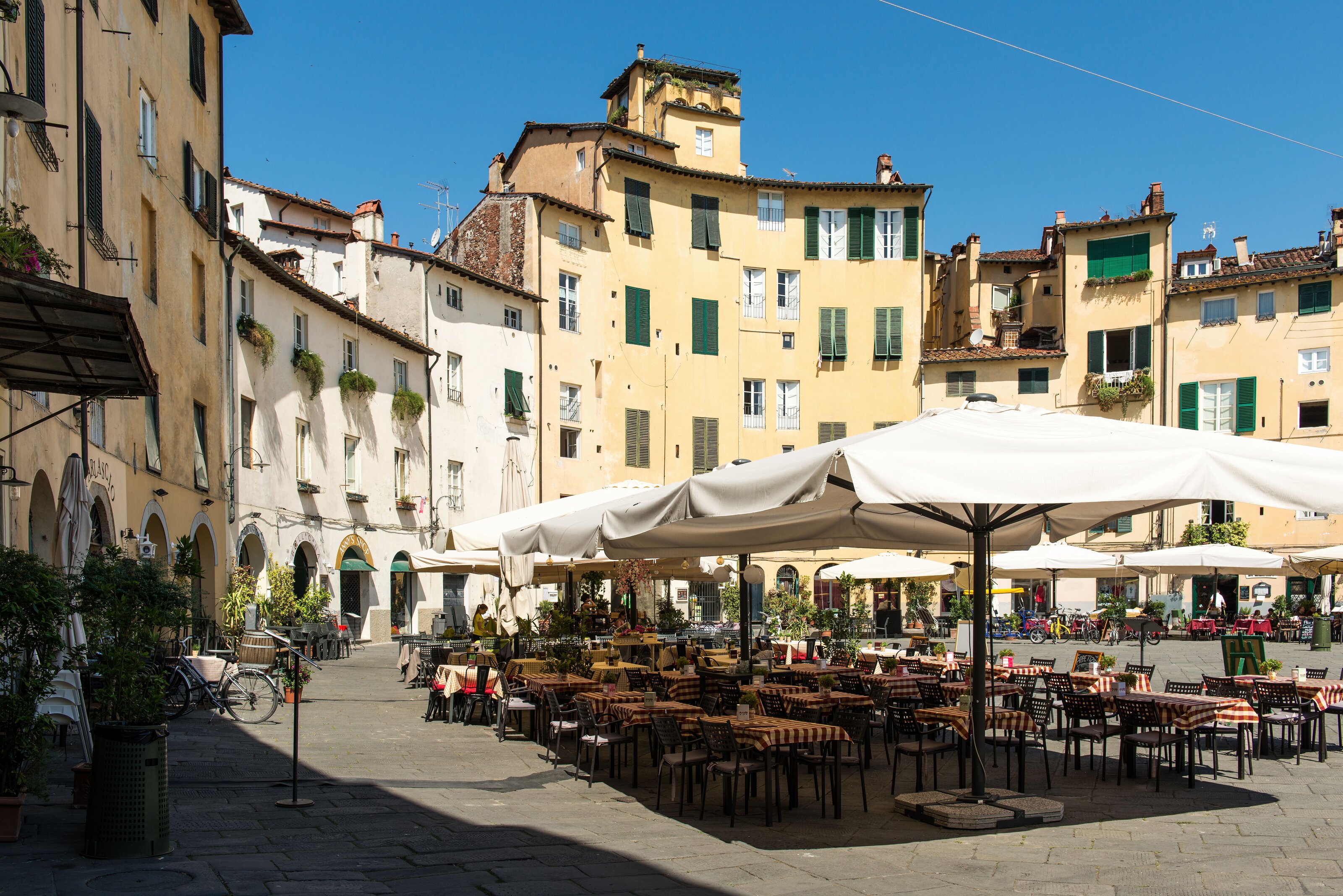
Piazza dell'Anfiteatro
Highlight · Lucca
Torre Guinigi rooftop oaks
Highlight · Lucca
About Lucca
A short history
Lucca's strangeness comes from a date that didn't happen. Most Italian city-states fell to one larger power or another between 1400 and 1530 — Lucca stayed independent until 1799, then again under the Bourbons until 1847. It never became part of Florence's empire, never had a Renaissance overlord rebuilding it, never had the kind of catastrophic 19th-century industrial growth that flattened so many other small European cities.
What's left is one of Europe's best-preserved late-Renaissance walled cities. The walls themselves — 4.2km of pristine 16th-century bastions — are intact end-to-end and now form the city's main park, used by Lucchesi as a running track, a bike path and a place to walk the dog.
Inside the walls the medieval street grid sits on top of the original Roman one. Piazza dell'Anfiteatro is shaped like an oval because it was — Roman amphitheatre stones forming the foundation of the houses that line it. The cathedral has Tuscany's oldest crucifix (the Volto Santo, 8th century, with its own dedicated September procession), and the city is the birthplace of Giacomo Puccini — La Bohème, Tosca, Madama Butterfly all written here or nearby.
Where to base
Lucca is genuinely small. Inside the walls is 800 metres wide and 1.2km long; you can cross it in 15 minutes. Two useful pockets:
Centro Storico. Around the cathedral and Piazza Napoleone. Mid-priced (€140–€220 for a small hotel), close to everything, evening passeggiata at your door. Our default.
Near Piazza dell'Anfiteatro. The most atmospheric corner of the city — pricier but worth it for a 2+ night stay (€180–€280). Stay above one of the cafés that ring the square if you can find availability.
Country agriturismo. The Lucchesia is a beautiful agricultural landscape of olive groves and small wineries. Staying out and driving in works if you're touring; the closest agriturismi are in Capannori (8km east) and the Garfagnana foothills (20km north).
Lucca is also the easiest Tuscan city to do as a day-trip base from Pisa or Florence — 30 minutes by train. One night here unlocks the morning walls walk and the evening, which are the best parts.
What to see
The walls. Walk or cycle them. Bike rental shops at the city gates do hourly rates (€4–€6) or daily (€14–€18). The 4.2km loop is flat, shaded by chestnut and plane trees, and offers the best aerial-ish view of the city. Allow 30 minutes by bike, 90 on foot.
Piazza dell'Anfiteatro. Oval-shaped, Roman in origin, lined with cafés and bookshops. Get there for an espresso at 8am before the day groups arrive, then again at 8pm for the evening crowd of locals.
Cathedral and Volto Santo. The duomo (San Martino) has a black-faced 8th-century crucifix carved, by legend, by Nicodemus from the cedar of Lebanon. The September Luminara procession carries it through the city — every window lit by candle, 30,000 attendees. The Tintoretto Last Supper and Jacopo della Quercia's tomb of Ilaria del Carretto are inside the same building.
Torre Guinigi. The medieval tower with oak trees growing on its roof. 230 steps up, panoramic view across the terracotta rooftops to the Apuan Alps. Best in late afternoon when the light goes orange.
Puccini's birthplace. Now a small museum at Corte San Lorenzo 9, with original manuscripts, his piano and his costumes from early productions. Combine with a summer-evening performance at the Puccini Festival in Torre del Lago, 20km west — open-air opera by his villa.
Via Fillungo. Lucca's main shopping street, but the focus here is small family-run businesses — leather, ceramics, bookbinders, an opera-music shop, the historic Caffè Di Simo where Mascagni and Pascoli held court.
What to skip
The Comics & Games convention (early November). Lucca Comics is one of Europe's biggest gaming and comics festivals. It's wonderful if you're going for it; it's hell if you're not. Avoid the last week of October and first week of November unless you've bought a pass.
Restaurants on Piazza Napoleone. Wrong square — Napoleone is administrative (town hall, theatre, library) and the few cafés there are tourist-priced. Eat on Piazza San Michele or in the streets around Piazza dell'Anfiteatro instead.
Driving the walls. The walls are pedestrian/cycle-only. Don't try; you can't.
Best time to visit
April–June. Lucca's golden window. Wisteria in bloom in May, walls at their greenest, the Lucca Summer Festival just starting (June–July, big-name acts at Piazza Napoleone — Bob Dylan and Tom Jones have both played).
July–early August. Hot but lively, festival season. Many shops close mid-August.
September. The Luminara di Santa Croce on 13 September is the year's most beautiful evening — entire city lit by candle, the Volto Santo carried through the streets. Free, atmospheric, deeply local.
October. Quiet, mild, harvest season for olive oil (the Lucchesia is one of Italy's best oil regions). Avoid the last week if you don't want the Comics convention.
Winter. The walls are at their most atmospheric in fog or low sun. Rooms 30–40% cheaper, every restaurant open. December has small Christmas markets that are pretty without being commercial.
Getting there
By train. Pisa Centrale → Lucca is 30 minutes (€3.80). Florence → Lucca is 1h 25 with a change at Pisa, or direct on a few daily trains (~80 minutes). Both routes drop you outside the walls; walk in through Porta San Pietro.
By air. Pisa airport (PSA) is the practical option — 30 minutes by direct train. Florence (FLR) is 90 minutes via train.
By car. The A11 from Florence is direct (1h 15). Park outside the walls — the ring road has several large lots at €15–€20/day — and walk in.
Day trips from Lucca
Pisa — 30 minutes by train, half a day. Best paired with Lucca on a single trip; many travellers do Lucca morning, Pisa afternoon.
Torre del Lago — 20 minutes by car, Puccini's lakeside villa with summer opera under the stars (mid-July to mid-August). Combine with lunch in Viareggio — 25 minutes by direct train from Lucca, with 4km of Liberty-era seafront beach clubs. The wider Massa-Carrara Versilia stretch continues north.
The Garfagnana — chestnut forests, mountain villages, traditional farro-and-mushroom cooking. Castelnuovo di Garfagnana is the natural base. 45 minutes by car; the Apuan Alps traverse launches from here.
Forte dei Marmi — 35 minutes by car or train. The most exclusive Versilia beach town; designer beach clubs and a Wednesday market that draws bargain-hunters from across Europe.
Cinque Terre — 90 minutes by train to Riomaggiore via La Spezia. Long day; better as an overnight if time allows.
Practicalities
Bike rental. Most rentals are around Porta San Pietro and Porta Santa Maria, hourly rates €4–€6. E-bikes available if the walls or the Garfagnana are on your route. Helmets free; lock included.
Eat. Tordelli lucchesi (meat-stuffed pasta in ragù), buccellato (sweet aniseed bread, a Lucchese specialty for centuries), torta co' becchi (greens-and-rice pie). Drink Colline Lucchesi reds; the local olive oil is among Italy's best — buy a bottle direct from a producer in Capannori.
Festivals. Luminara di Santa Croce (13 September, the year's most beautiful evening), Lucca Summer Festival (June–July, big-name concerts), Lucca Comics (early November — avoid unless going for it), Puccini Festival (Torre del Lago, mid-July to mid-August).
Read first. Our practical basics page covers Italian trip logistics — money, transport, when to come.
Read our practical basics before you book — when to come, where to base, how to get around.