 ← All stories
 Soaking at Saturnia, free and paid
The cascade everyone posts about, plus three quieter alternatives within 20km — and the rules nobody tells you.
The cascade everyone posts about, plus three quieter alternatives within 20km — and the rules nobody tells you.
Why Tuscany has so many thermal pools
The geology underneath southern Tuscany is volcanic. Mount Amiata, a dormant volcano in the Siena/Grosseto border country, sits on a heat anomaly that warms ground water across a wide arc — from Bagno Vignoni in the north to Saturnia in the south, through Petriolo, Bagni San Filippo, Sorano, and a dozen smaller pools. The water emerges between 37°C and 51°C, rich in sulphur and calcium bicarbonate.
The Romans built spa complexes on these springs (Saturnia's first baths predate Christianity by 700 years). The Etruscans were there first. Today the springs split into two categories: the free natural pools, where the water emerges from the ground and runs into terraces — popular, public, free, no facilities; and the paid spa hotels built on top of the same springs — quieter, with showers, towels, restaurants, and €30–€80 entry.
Both have their place. This guide covers the four main free pools plus their paid counterparts.
Cascate del Mulino — the famous one
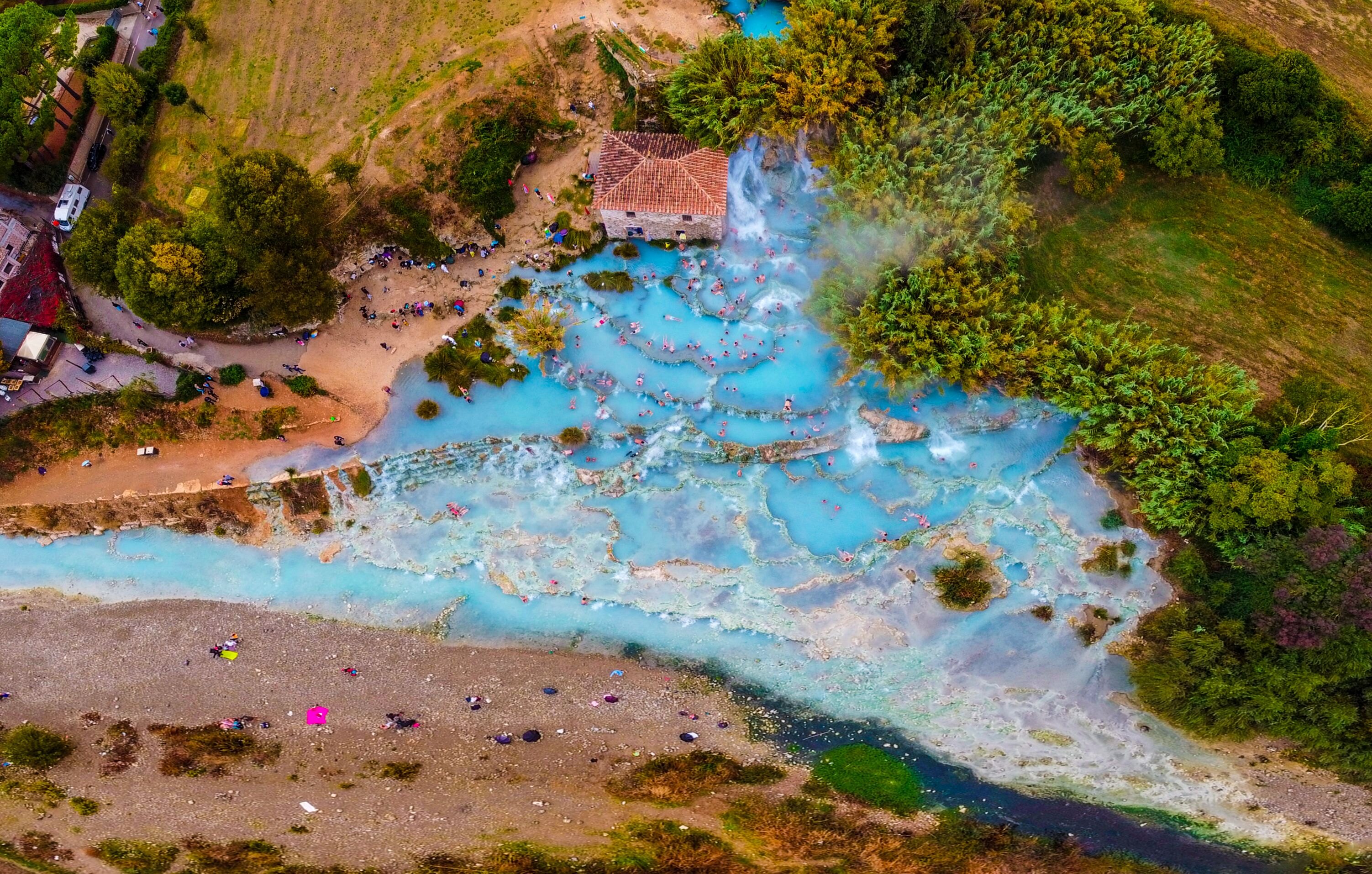
The free travertine cascade at Saturnia is the photographed-to-death one. White layered limestone terraces with warm sulphur water cascading down, set against open Maremma countryside. Beautiful. Crowded.
Practicalities. Free, open 24 hours, no booking. Parking €5 cash in season (April–October), free outside. Located 1.5km outside Saturnia village (signposted Mulino di Saturnia or Cascate del Mulino). The water is 37°C year-round.
Best time. Dawn and late evening. The 18:00–22:00 window after most day-trippers leave but before the night-owls arrive is the sweet spot. Mid-week is markedly quieter than weekends. In August, especially Ferragosto week, the pools are full at any hour.
What it's actually like. The terraces fit about 80 people comfortably; in midday peak there are 200+. The terraces are slippery — flip-flops mandatory. The bottom of each pool is sandy travertine; you'll lie back in 30cm of water. There are no facilities, no changing rooms, no toilets — change at your car. Don't leave anything in the car worth stealing; thefts are common.
Terme di Saturnia spa — the paid version
150 metres uphill from the free cascade. The same spring water (this is upstream of Cascate del Mulino), routed into a series of paid pools with lifeguards, lockers, towel service, and a restaurant. Run as a 5-star hotel and spa.
Day access. €30 weekdays low season; €50 summer weekends. Includes towels, lockers, robe rental optional (€10). Open 09:30–19:00. Reservation recommended.
Worth it when. You want the same water without the crowds, you have a young family (the free pools are slippery for under-5s), it's raining and you want indoor pools too, or you want to soak before a nice dinner at the on-site restaurant.
Bagni San Filippo — the white whale
30 minutes east of Saturnia, on the southern flank of Mount Amiata. White travertine pools tucked into a beech forest — the centrepiece is the Balena Bianca (White Whale), a giant calcareous formation shaped exactly like its name.
Practicalities. Free, open 24 hours. Trailhead from the village of Bagni San Filippo (parking €3); 10-minute walk down through forest to the pools. The water emerges at 48°C and cools as it flows downstream, so different terraces have different temperatures — try a few before settling.
Why it's special. The forest setting is the opposite of Saturnia's open landscape. Smaller crowds (perhaps 30–50 people on a busy day, against Saturnia's 200+). No flat travertine terraces; instead a series of rocky pools and small cascades. The most photogenic pool, around the Balena, is best at midday when light filters down through the canopy.
Petriolo — the riverside one
60 minutes north of Saturnia (between Grosseto and Siena, just off the SS223). Free thermal pools beside the Farma River, with a 13th-century stone bridge above.
Practicalities. Free, open 24 hours. Parking on the roadside (free, but tight). The pools are an easy 5-minute walk down from the road. The thermal water (43°C) mixes with the cold river water, so you can pick a temperature by which pool you settle in.
Best for. Late afternoon — the western light through the bridge arches is special. Quieter than both Saturnia and Bagni San Filippo, but not deserted.
Bagno Vignoni — the village in the spring
An hour north of Saturnia, in the Val d'Orcia (see the wider Pienza and Val d'Orcia guide). Bagno Vignoni is a tiny medieval hamlet built around a single rectangular spring pool the size of a tennis court — Piazza delle Sorgenti is literally a piazza of warm water, not a piazza of paving. You can't swim in the main pool (it's protected) but the surrounding buildings have been converted to spa hotels.
Free option. Below the village, a 5-minute walk down the hill, the spring water cascades into a small free pool beside the river. Smaller and less spectacular than Saturnia but quieter.
Paid options. Adler Spa Resort (premium, €80 day access) or Hotel Posta Marcucci (€20 access to its single thermal pool). The village itself is a 20-minute visit — the spring piazza is the unique attraction.
What to bring
Flip-flops. All travertine pools are slippery. Rubber-soled water shoes are even better.
A dark swimsuit. Sulphur stains light fabrics permanently over a few visits. Don't wear your nicest white bikini.
Two towels. One to sit on while changing, one to dry off.
A water bottle. The pools are warm and you'll dehydrate faster than expected.
A head torch if going at dawn or after sunset.
What NOT to bring. Silver jewellery (sulphur tarnishes it). Anything valuable that has to stay in the car.
Practical tips and etiquette
No alcohol in the pools. Open bottles are tolerated in Italy but the warm water plus alcohol is a recipe for fainting. Save the wine for after.
Don't soap up in the pools. Obvious, often violated. There's no drainage; suds linger.
Maximum recommended soak time is 20 minutes per session. The 37°C water is hot enough that long sessions cause dizziness. Get out, cool down, get back in.
Pregnant women, those with heart conditions and small children should consult a doctor before bathing — the temperature and sulphur content aren't trivial.
Read next. Our Grosseto and the Maremma region pillar covers the wider area — Pitigliano, Sovana, the Etruscan vie cave — making a perfect 3-day round-trip combining thermal pools with the tufa towns.
Frequently asked.
- Are the Saturnia thermal pools free?
- The Cascate del Mulino — the famous travertine waterfall pools — are free and open 24 hours. The adjacent Terme di Saturnia spa hotel charges €30–€50 for day access to its quieter, sulphur-rich pools.
- What's the water temperature at Saturnia?
- 37°C year-round. The water comes out of the ground that warm and stays roughly constant — it's a geothermal vent, not a heated pool.
- What should I bring to the Cascate del Mulino?
- Flip-flops (the travertine is slippery), a dark swimsuit (sulphur stains light fabrics over time), a towel and a head torch if visiting at dawn or after sunset. Don't leave valuables in the car.
- Are there quieter alternatives to Cascate del Mulino?
- Yes — three within 20km. Bagni San Filippo is white travertine pools in woodland, Petriolo sits riverside by a medieval bridge, and the paid Terme di Saturnia spa hotel handles the bigger crowds when free pools fill up.
Keep reading.
Elba, by ferry and by bike
How to do the biggest Tuscan island without a car — hydrofoil, coastal buses and rented e-bikes.
Day trips from Florence by train
Twelve destinations reachable without a car, sorted by travel time and what to do when you get there.
Viareggio beaches — the train-accessible Tuscan riviera
Wide sand, Liberty-era beach clubs, and a station 800m from the sea. The most rail-friendly Tuscan beach town, decoded.