 ← All stories
 The Leaning Tower of Pisa, explained — and what else to see
Why the tower leans, how the engineers stopped it falling, and the four other monuments on the Piazza dei Miracoli most day-trippers never enter.
Why the tower leans, how the engineers stopped it falling, and the four other monuments on the Piazza dei Miracoli most day-trippers never enter.
Why the tower leans
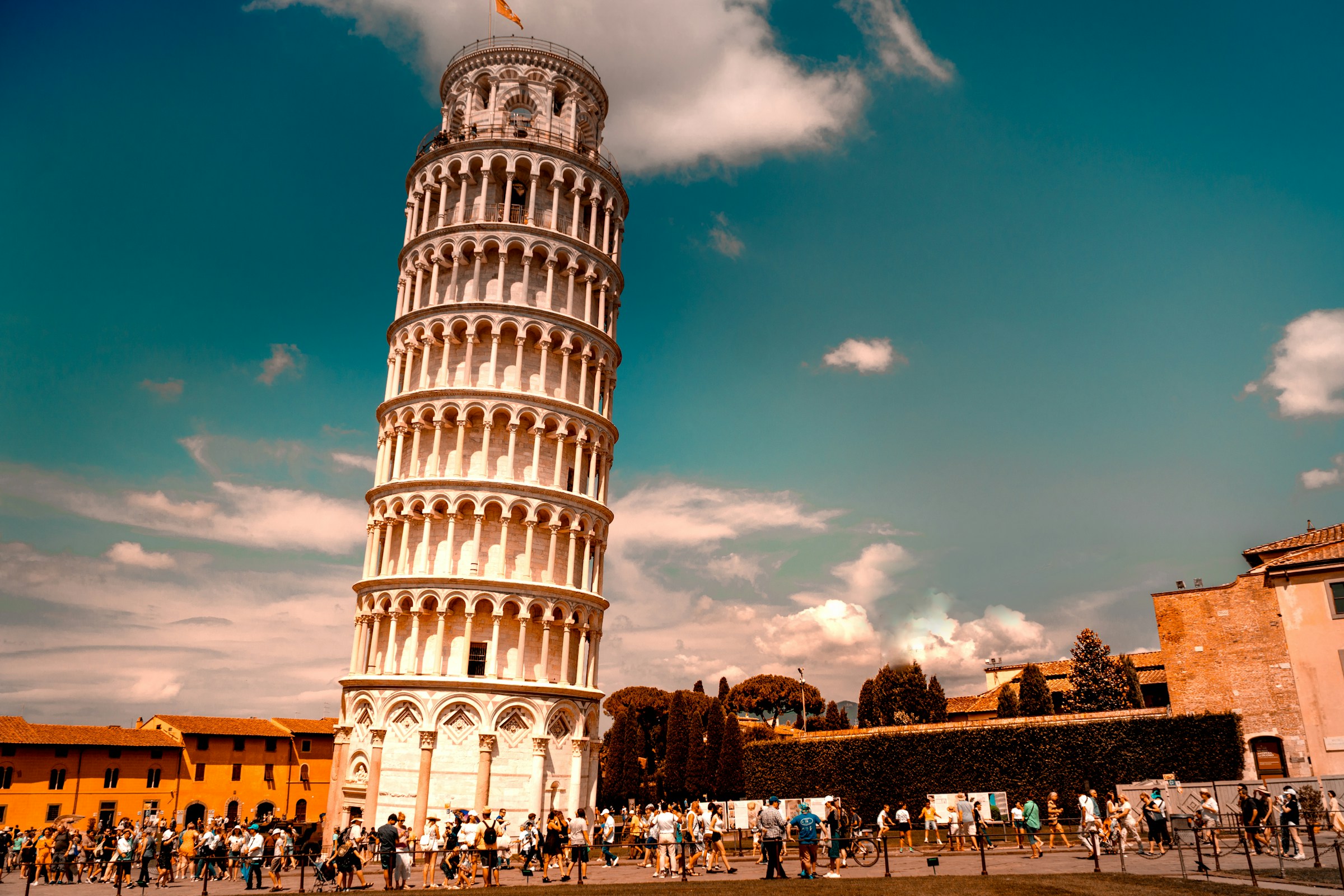
The short answer is unstable soil. The tower was begun in 1173 on the alluvial plain of the Arno, which is a sandwich of clay, sand, and groundwater — not load-bearing rock. The foundation is only 3 metres deep, which is nothing for a 56-metre stone tower weighing about 14,500 tonnes. The south side sat on a softer pocket of saturated clay; the north side on slightly firmer ground. As soon as the first floors went up, the south side began to settle faster. The tower started leaning south almost immediately — visible to the builders before they were a quarter of the way up.
Two long pauses saved it. Construction stopped between 1178 and 1272 because of war with Genoa and the deaths of the original architects; this 94-year break let the soil consolidate and partially stop the settlement. A second pause came after Pisa lost the naval battle of Meloria to Genoa in 1284. In each pause, the soil compacted enough that adding more floors didn't simply make the south side sink further. If the medieval Pisans had built the tower in one go, it would have toppled long ago.
When construction resumed, the builders tried to compensate by curving the upper floors back towards the vertical — the tower today is actually subtly banana-shaped, not a straight cylinder. You can see this with a careful eye from the north side: the bell chamber at the top is offset slightly relative to the bottom-floor centre. Even after curving, the tower was completed in 1372 already leaning more than a metre off vertical at the top.
How it was stopped from falling
The lean kept increasing for 600 years — roughly 1mm per year. By 1990 the tower was leaning 4.5 metres off vertical at the top (a 5.5° angle from vertical) and engineers calculated it had between 30 and 50 years of stability left. The Italian government closed it to visitors and convened an international rescue committee.
The fix that worked was counter-intuitive: soil extraction. Engineers led by John Burland of Imperial College London drilled angled holes into the north side of the foundation and removed small amounts of clay. The north side, deprived of support, settled gently downwards — pulling the tower north and reducing the lean. The work ran from 1999 to 2001. The tower was straightened by 44 centimetres and is now considered stable for at least another 300 years.
The tower is monitored by 480 sensors. It's still leaning — about 3.9 metres off vertical at the top, or roughly 4° — which is exactly the engineers' target: visibly leaning enough to remain the Leaning Tower, structurally safe enough to climb.
Climbing the tower today
Tickets cost €20 for the tower alone, €27 for tower + cathedral + one other monument, €37 for the full Piazza dei Miracoli combined ticket. Book online at opapisa.it ahead of arrival — same-day walk-up tickets in summer often sell out by 11am. The booking is for a specific 30-minute time slot.
The climb. 273 steps up a spiral inside the tower wall. The lean is genuinely disorienting — you feel the floor tilting underfoot, especially in the upper levels. Children under 8 are not admitted. No bags allowed; there is a free locker at the entrance. Allow 45 minutes total: 15 for the queue, 15 for the climb, 15 for the bell chamber and the descent.
The view. The bell chamber at the top gives you the cathedral apse from directly above, the entire Piazza dei Miracoli laid out below, and the Apuan Alps to the north (often snow-streaked even in summer — see our Apuan Alps traverse). On clear days, the Mediterranean is visible 12km west.
Best time slots. 8:30am (first entry, smallest crowd) or 5:30pm last summer slot (best light for photos). Midday slots have the strongest sun on the marble and the largest queues.
The Cathedral — the building the tower was built for
Most visitors photograph the tower and skip the cathedral. This is a mistake. The Duomo di Pisa is one of the most important Romanesque cathedrals in Italy — begun in 1063 and consecrated in 1118, more than half a century before the tower. The whole Piazza dei Miracoli ensemble was built to serve the cathedral, and the tower (1173) and baptistery (1153) are the cathedral's accompanying buildings.
What to look for. The cathedral's facade is the prototype of the Pisan-Romanesque style — four levels of arched colonnades stacked above the entrance, used as the template for cathedrals across central Italy. Inside: a coffered gilt ceiling, the Giovanni Pisano marble pulpit (1310, one of the medieval masterpieces of Italian sculpture, comparable to anything in Florence), the apse mosaic of Christ Pantocrator by Cimabue, and the bronze entrance doors of Bonanno Pisano (1180). Allow 40 minutes.
Free entry with any combined ticket. Cathedral entry alone is free but requires a timed ticket pulled from the box office — you'll still need to queue briefly.
The Baptistery — Italy's largest, and the acoustic trick
The Baptistery of San Giovanni is the third building of the Piazza dei Miracoli — circular, marble, 55 metres tall, the largest baptistery in Italy. Begun in 1153 and finished 1363. From outside, it looks like a smaller round version of the cathedral; inside, it is enormous and largely empty.
What to look for. The Nicola Pisano marble pulpit (1260) — the artistic breakthrough that began the Italian Renaissance sculpture tradition, two centuries before Donatello. Look at the hexagonal panels showing the Nativity and the Crucifixion; the figures are no longer flat Byzantine icons but rounded, dramatic, individual. Art history textbooks date the start of the Italian sculptural Renaissance to this exact object.
The acoustic trick. Every 30 minutes, a baptistery staff member sings two notes from the centre of the floor. The double-shelled dome creates a 10-second reverb that turns the two notes into a slow, shifting chord — the sound seems to come from above the singer and to keep moving as the harmonics decay. It is the strangest acoustic experience you will have in Italy. Try to be inside for one of these demonstrations (roughly :00 and :30 past the hour).
The Camposanto and the Museo delle Sinopie
The fourth building on the Piazza dei Miracoli is the Camposanto Monumentale — a long covered cloister surrounding a rectangular courtyard, used as the city cemetery from the 13th century until 1779. The walls were once entirely covered in 14th-century frescoes by Buffalmacco, Taddeo Gaddi and Benozzo Gozzoli — including the celebrated Triumph of Death, painted in the aftermath of the 1348 Black Death.
A 1944 American artillery shell hit the Camposanto roof, melting the lead covering and damaging most of the frescoes. The restoration recovered what it could; the frescoes that survived are in their original wall positions. The Triumph of Death is still here, partly restored, and remains one of the most powerful late-medieval images in Europe — a 12-metre-long allegory of plague-era anxiety.
The Museo delle Sinopie across the piazza is the under-rated companion. When the frescoes were detached from the walls for restoration, the underlying preparatory drawings (the sinopie) became visible — and those drawings are now displayed inside. They give you the artists' first thoughts before the paint went on. Twenty minutes; about a third of visitors miss it entirely.
Beyond the Piazza dei Miracoli — the real Pisa
95% of Pisa's day-trippers see only the Piazza dei Miracoli and walk straight back to the train. They miss the city itself, which is a thoroughly likable Tuscan university town — see our Pisa region pillar for the wider context.
Piazza dei Cavalieri. 8 minutes south of the Piazza dei Miracoli. The political square of medieval Pisa, redesigned by Vasari in the 1560s for Cosimo I de' Medici. The palace facades have sgraffito decoration (etched stucco) by Vasari. The Scuola Normale Superiore — one of Europe's most selective universities, founded by Napoleon in 1810 — occupies the main palazzo. Walk through under the arch if a student lets you.
The Lungarni and Piazza dei Cavalieri. The riverside boulevards along the Arno, lined with pastel-coloured Renaissance townhouses. Pisa's most photographable views after the tower. Walk both sides between Ponte Solferino and Ponte di Mezzo, ending at the small Santa Maria della Spina — a tiny Gothic chapel directly on the Arno wall, said to once have held a thorn from Christ's crown.
Piazza delle Vettovaglie. The original food market square, ringed by 15th-century arcades. Weekday mornings see a working market; evenings see a student-aperitivo crowd. The piazza-side bars (Bazeel, Caffè dell'Ussero) are the place for an evening Negroni Sbagliato.
Borgo Stretto. The pedestrian shopping street between Piazza dei Cavalieri and the river. Arcaded both sides, full of small bookshops, the third-best gelateria in Tuscany (De' Coltelli), and the Caffè dell'Ussero — a literary café opened in 1794, the meeting place of the Italian Risorgimento intellectuals.
Where to eat
Pisa's food culture is closer to the Livorno coast than to Florence — heavier on fish, lighter on Bistecca alla Fiorentina. The student population keeps prices honest.
Osteria dei Cavalieri (Via San Frediano, 16). The most reliable mid-priced Pisan kitchen. Trippa alla pisana, baccalà fritto, an excellent cinghiale ragù. €40–€55 per person.
Osteria del Porton Rosso (Vicolo del Porton Rosso, 1). Half a block from the river. Fritto misto, spaghetti alle arselle (with tiny clams from the Pisan coast), Vin Santo with cantucci. €45–€60 per person.
Pizzeria Il Montino (Vicolo del Monte, 1). Cecina — the chickpea-flour focaccia of the Tuscan coast — sold by the slice and folded into a flat roll with mozzarella, salami or anchovies. €5–€8 a meal, walk-in only.
De' Coltelli (Lungarno Antonio Pacinotti, 23). The famous gelateria, on the Lungarno. Sicilian-style granita in summer. The basil-lemon flavour is the local signature.
What to drink. Chianti Colli Pisani (lighter than Chianti Classico) with red-meat dishes, or a Vermentino from the Lucca hills with fish — see the food and wine pillar for the wider Tuscan landscape.
Getting there and getting around
Pisa Centrale station is the rail hub for the western Tuscan coast. The Leaning Tower is 1.5km north — a 20-minute walk via Corso Italia and Borgo Stretto, or a 6-minute hop on the LAM Rossa bus.
From Florence Santa Maria Novella. 55 minutes by direct regional train (€8.90), twice an hour. Frecciarossa cuts this to 45 minutes (€18) but costs twice as much and the time saving is marginal. Standard day-trip choice. Full Florence-rail playbook in our day-trips-from-Florence-by-train guide.
From Lucca. 30 minutes direct, €3.50. The natural pairing — many visitors do Pisa + Lucca on a single day from Florence.
From Viareggio. 20 minutes by direct regional, €3.50. Pisa + Viareggio is the canonical "culture morning, beach afternoon" Tuscany day.
From Pisa airport (PSA). The PisaMover automated shuttle connects the airport terminal to Pisa Centrale in 8 minutes (€5). The tower is then a 20-minute walk or a single bus stop.
By car. Park at Parcheggio Pietrasantina (free) on the north edge of the city; a free shuttle runs to the Piazza dei Miracoli. Don't try to drive into the historic centre — most of it is a ZTL.
How long to spend
Half a day. Climb the tower (45 min) + cathedral (40 min) + baptistery (30 min) + lunch on the Lungarno. The mass-market itinerary. Trains back to Florence every 30 minutes.
Full day. Add the Camposanto + Museo delle Sinopie (1 hour combined), Piazza dei Cavalieri (30 min), the Lungarni walk (45 min), Borgo Stretto + an evening drink at Caffè dell'Ussero (1 hour). This is the version where Pisa earns more than a photograph.
Overnight. Worth it if you want to climb the tower at the 8:30am first slot (no day-trippers yet) or the 5:30pm last summer slot (best light). The Royal Victoria Hotel on the Lungarno is the canonical literary hotel — Byron, Dickens and Ruskin all stayed; the upper-floor river-view rooms are €160–€240.
Read on
Our Pisa region pillar covers the wider province (Pisan hill towns, the Tuscan coast, Volterra). For the truffle town between Pisa and Florence, see the San Miniato truffle guide. For the easy beach-day pairing, see Viareggio beaches; for the island day-trip, see Elba by ferry and by bike.
Frequently asked.
- Why does the Leaning Tower of Pisa lean?
- The 56-metre tower was built on a 3-metre-deep foundation on alluvial Arno clay. The south side sat on softer ground and began settling faster as soon as the first floors went up in 1173. Two long construction pauses (1178–1272 and after 1284) let the soil partly consolidate; without them, the tower would have toppled centuries ago. The lean today is about 3.9 metres off vertical at the top.
- Is the Leaning Tower still falling?
- No — the 1999–2001 soil-extraction engineering project led by John Burland of Imperial College London corrected the lean by 44cm and is considered stable for at least another 300 years. The tower is monitored by 480 sensors. Its current 4° tilt is intentional — kept visible enough to remain the Leaning Tower, structurally safe enough to climb.
- How much does it cost to climb the Leaning Tower of Pisa?
- €20 for the tower alone; €27 for tower + cathedral + one other monument; €37 for the full Piazza dei Miracoli combined ticket (tower, cathedral, baptistery, Camposanto, Museo delle Sinopie, Museo dell'Opera del Duomo). Book online at opapisa.it for a specific 30-minute time slot.
- How long does it take to visit Pisa?
- A half-day is enough for the Piazza dei Miracoli alone (tower climb, cathedral, baptistery). A full day adds the Camposanto, Piazza dei Cavalieri, the Lungarni and dinner. Pisa rewards a full day; most day-trippers leave too early.
- How do I get from Florence to Pisa?
- Direct regional trains from Florence Santa Maria Novella, 55 minutes, €8.90 one-way, twice an hour. Pisa Centrale station is 1.5km from the Leaning Tower — a 20-minute walk or a 6-minute bus. Frecciarossa high-speed cuts this to 45 minutes (€18) but the regional is the standard day-trip choice.
- What else is there to see in Pisa beyond the Leaning Tower?
- The three other monuments of the Piazza dei Miracoli (cathedral, baptistery, Camposanto) are world-class and routinely skipped — particularly the baptistery's Nicola Pisano pulpit, the cathedral's Giovanni Pisano pulpit, and the Camposanto's Triumph of Death fresco. Beyond the piazza: Piazza dei Cavalieri, the Lungarni river walks, Santa Maria della Spina, Piazza delle Vettovaglie, and Borgo Stretto. Pisa is a working university town, not just one monument.
Keep reading.
Seven slow days across Chianti
A practical itinerary between Florence and Siena — with three cellars worth the detour.
Hiking the Apuan Alps above Carrara
Marble mountains, chestnut woods, refuges serving polenta. A three-day traverse, and how to do it.
Pienza and the Val d'Orcia, a guide
The Renaissance-pope's experiment in town planning, and the photogenic countryside around it.